
Why your Meta CPA is not your real CPA
Meta counts the results it can see, and the sale happens in your ticketing platform. Your real cost per ticket, and why the algorithm works against you.
Stop allocating budget blindly. See the real ROI of every channel — email, SMS, WhatsApp, Meta Ads, Google Ads and TikTok Ads — in a single dashboard. Cross-channel attribution integrated with your CRM and ticketing, no external tracking needed.
See exactly how many tickets each channel sold: email, SMS, WhatsApp, Meta Ads, Google Ads and TikTok Ads. Compare owned media (your database) vs paid media (advertising) in real time. No manual integrations — Nevent connects all channels natively because it manages them all from the same CRM.
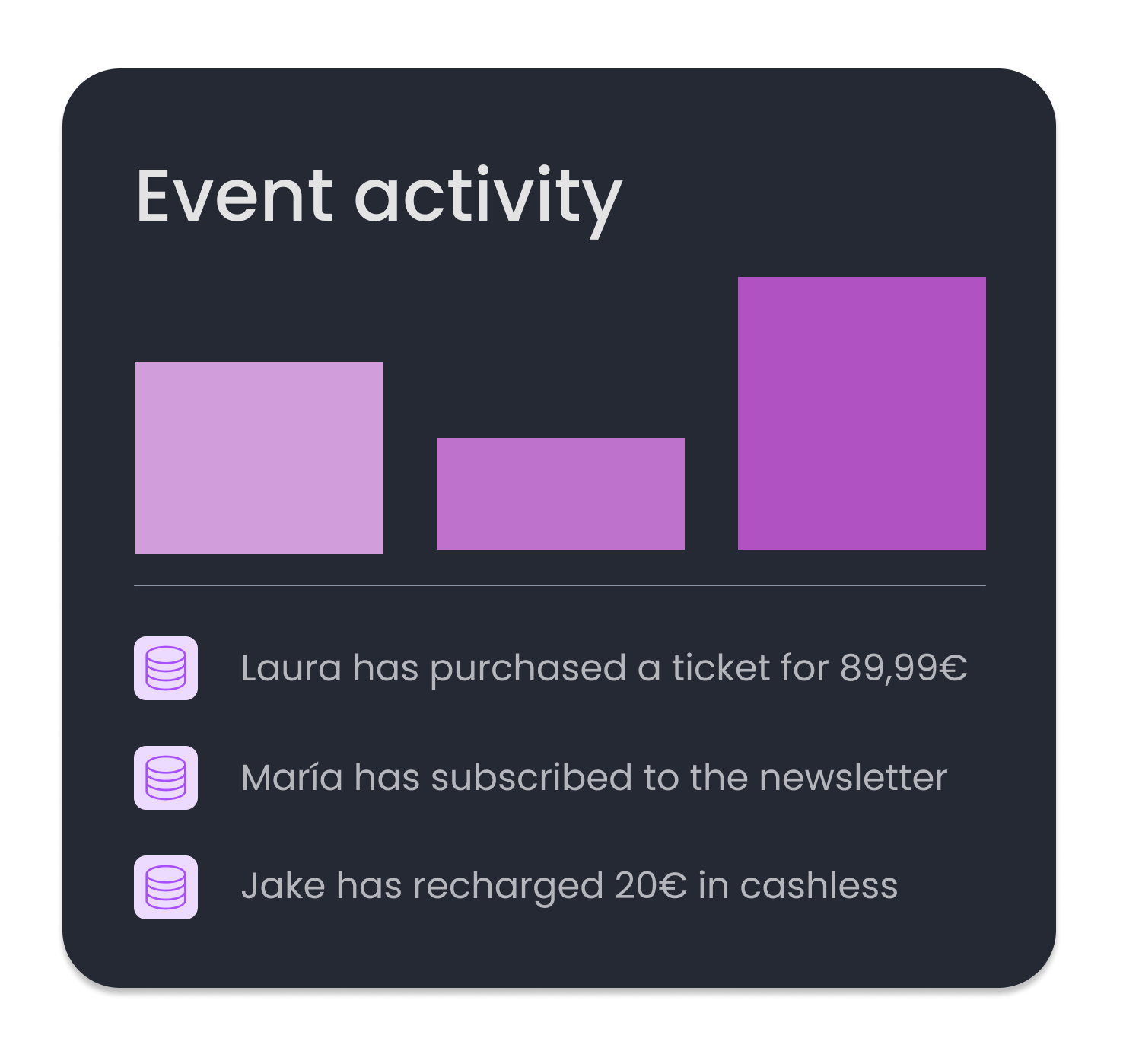
How much you spent on each channel and how much it generated in ticket sales. Revenue attribution by campaign, by channel and by audience segment. Identify which campaigns have the best cost per ticket sold and redistribute budget where it actually works.
The way someone buys a festival ticket is nothing like the way they buy a club ticket. For festivals the journey lasts weeks; for clubs the decision happens the same evening. That's why Nevent doesn't use generic attribution models from marketing platforms: we have a proprietary model trained on real attendee behavior data, distinguishing between festivals, nightlife, concerts and venues. You know which channel is actually selling for you based on the kind of event you run, not based on a formula built for an online store.
Visualize every touchpoint from first contact to ticket purchase. Discover which combination of channels converts best — by event type, attendee profile and funnel stage. Information no external tool can give you because it lives inside the CRM.
In e-commerce, the purchase cycle can be hours or days. In events, a fan might discover a festival in January, interact with multiple channels over months and buy in March. Generic attribution misses most of these touchpoints. Nevent is built on the event CRM, meaning it has access to the fan's complete history: which emails they opened, which events they attended, when they bought in previous editions. That long history is what gives real attribution its meaning.
No. The advantage of Nevent is that it manages all channels from the same platform. When a fan buys a ticket after opening an email, clicking an SMS or interacting with a WhatsApp campaign, it's all in the same system. For paid media (Meta, Google, TikTok), Nevent connects with advertising APIs to cross-reference conversion data. The result is frictionless attribution that doesn't depend on third-party pixels that can be blocked or lost.
We don't use the generic models that come built into advertising platforms. Our attribution model is trained specifically on live entertainment purchase behavior, and it recognizes that a festival, a nightclub or a concert are bought in very different ways. For a festival the cycle can last weeks and go through five channels before the purchase. For a club, the decision happens the same evening. The model weights each channel based on the kind of event, it doesn't apply a universal formula. That means the attribution you see reflects how things actually sell in your sector, not how they would sell in an online store.
The attribution dashboard shows, for each channel, the cost invested and the revenue generated in tickets. The cost of email and SMS comes from the Nevent plan; the cost of Meta Ads, Google or TikTok you enter manually (or we connect via API). With both data points we calculate the ROI and cost per ticket sold for each channel. Most promoters discover that their own database has an ROI 3-5 times higher than paid advertising — precisely because these are fans who already know them.
Yes. You can cross attribution data with any CRM segment. For example: "which channel converts better for returning fans vs new fans?" or "does email work better for VIP tickets and Meta Ads for general admission?". This segmentation is possible because attribution lives inside the same CRM that contains the complete profile of each attendee, not in an external analytics tool disconnected from purchase data.
Yes, and small promoters are precisely where the difference vs. generic attribution shows the most. Our model leans on aggregated industry patterns from live entertainment, so you don't need thousands of your own sales for it to be reliable from your very first event. As you accumulate history edition after edition, the attribution adjusts to your specific reality and becomes more precise for your case. Small promoters get real value from the first campaign; larger ones get a very specific view of their event after 2-3 editions.
It's one of the most powerful metrics in the dashboard: owned media vs paid media. In owned media we group email, SMS and WhatsApp — the channels you use on your own database. In paid media we group Meta Ads, Google Ads and TikTok Ads. Seeing the comparison of both groups gives you the answer to the question every promoter asks: "is it worth building my own database or is it more efficient to pay for advertising?". The answer, almost always, is both — but in proportions that only your own business data can reveal.
Meta counts the results it can see, and the sale happens in your ticketing platform. Your real cost per ticket, and why the algorithm works against you.

Open rate cannot tell a good campaign from a bad one. Three metrics that actually mean something, and two habits you can adopt without changing tools.

Posters, street teams, radio and social compete for budget with no data behind it. Here is how to measure the channels that leave no trace today.













Learn how Nevent can take your events to the next level
Leave us your email and we will send you ideas, guides, and updates to get the most out of your marketing
Leaving?
We will email you the full audience segmentation guide for festivals and events. Free, no spam.